

THE PROCESS AT A GLANCE
Three documents, one discrepancy
Example review; requirements depend on the goods and procedure.
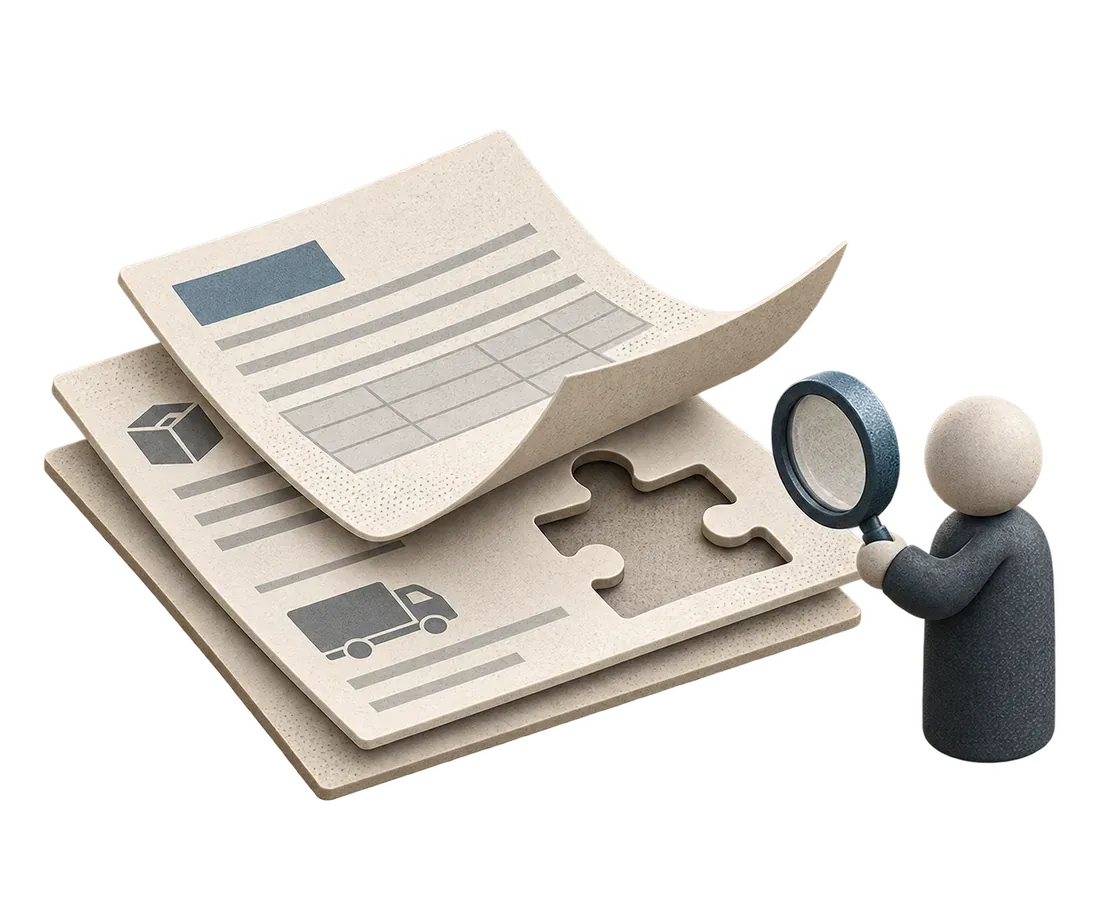
- Read the invoice reference and quantity
- Check the packing list and transport record
- Flag the exact difference with its source for review
A bill of lading mismatch means a transport document and another shipment record disagree on a fact that matters to review. The cause could be an outdated version, an OCR error, a wrong-shipment attachment or a genuine document discrepancy.
An import coordinator needs the conflicting values and their sources before asking for a correction. Selecting whichever value looks most plausible can conceal the original problem.
Compare like facts from the same shipment
Start with the dossier, shipment and document versions. Confirm that the invoice, packing list and bill of lading belong to the same movement.
Then check the selected references and fields under agreed rules. Container numbers, bill-of-lading references, parties, package counts and weights can be useful, but they do not all mean the same thing. Gross and net weight should not be compared as interchangeable measures.
A formatting difference may be harmless. A changed identifier may refer to a different shipment. Preserve the original values while applying only justified normalization rules.
Worked example: a one-character container difference
Illustrative documents: the current bill of lading states container ABCU1234567, while another dossier document states ABCU1234568. The system should show both source pages and the character difference.
A reviewer first checks the PDF and extraction. If the source page actually says ABCU1234567, correct the extracted value and re-evaluate. If the source documents themselves differ, the responsible parties must establish which document requires correction.
Now suppose a packing list states 18,400 kg net weight and the bill of lading states 19,100 kg gross weight. The 700 kg difference alone is not proof of an error. Agree the weight basis and packaging context before flagging it as a commercial discrepancy.
What OCRAgent actually compares
OCRAgent's import workflow extracts facts with source-page evidence and compares selected identifiers, including declaration, bill-of-lading and container references. Conflicting identifiers produce a reviewable finding. Low-confidence or unknown material can require human review.
Additional weight, package and required-field comparisons depend on the configured rules and usable extraction. Kaliits tests the chosen fields on representative documents rather than claiming every transport field is already covered.
The output supports a decision: conflicting values, source locations, rule and review outcome. It does not amend the issued transport document.
A real dossier example, with a specific limit
For Tedi Services, Mehdi Kourchal developed an OCR agent and tested it on a real Delassus case involving a significant discrepancy between an ONSSA document and a CMA CGM bill of lading.
That published account supports a real document-conflict test. It does not disclose the disputed values, quantify savings or establish a wider production rollout. The container and weight examples above are illustrative and are not reconstructions of that client dossier. Read the public evidence.
Smatch and Wawa Creative demonstrate other automation experience. Their response-coverage and product-listing results do not establish transport-document performance.
Keep correction requests under the issuer's process
Once the reviewer establishes a source-document conflict, identify the issuer and the party authorized to request a change. Preserve the original, correction request and replacement.
For example, Maersk's amendment guidance describes requesting a change and verifying the new version. The applicable process depends on your carrier and document state. OCRAgent's review report supports the request; it does not authorize the amendment.
Do not replace a source silently or mark a dossier ready merely because one new file arrived. Review the relevant comparisons again.
Measure evidence assembly and resolution
Track hands-on minutes finding the conflicting pages, confirming versions and preparing a correction request. Track external response time separately.
Illustrative inputs: twenty monthly conflicts needing twenty-five rather than ten hands-on minutes release five hours. Any avoided charge requires actual evidence and a defensible connection to the correction. A large shipment value is not a savings calculation.
Start with one document pair and one decision
Review import dossier control, then read how to choose a source of truth.
Map our bill of lading mismatch. Describe the conflicting field, document pair, current review method and person authorized to request a correction. The first discussion can determine the narrow comparison and test cases needed for a pilot.